VIRTUAL REALM OF REALITY
Jaime Ogston

Beyond the glass screen of your computer, tablet or phone
there is a whole other world created entirely from language. This is a world of
hash tags, communities, stories and followers. A world of going “live” and “tagging”.
Where for some, the virtual IS reality. This is Instagram.
What was originally created as a photo sharing application
has evolved into a realm where millions of communities made up of millions of
like-minded people gather to express their self. A simple search for almost
anything imaginable, from gypsy to gym junkie, preceded by a hash tag, will
direct you straight to one of these communities. But it is your own personal
Instagram page that is your springboard into truly immersing yourself in these
conceptually created spaces.
Tuan (1991) discusses how the art of storytelling has the
power to bring far off objects into the reality and that by adding certain
elements to this story we are able to create more emotional attachments to place.
This is just how the Instagram world works. Using the “stories” feature, one is
able to narrate and edit their life according to the communities they’re aiming
to establish an identity within. Upload a photo, add a few hash tags and you
are introducing yourself to your chosen community. And if your content is well
received then you will earn yourself some followers.
These followers are your very own tribe. Your Instagram page
becomes a place in its own right. A creation of your narration. Tagging others
will further establish your place. And going “live”, well that is just like
having virtual coffee with your new-found friends.
Drawing on the week five lecture, in which Dr Victoria
Kuttainen discussed the evolution of language, we can clearly see how the age
of the internet is changing our culture (Kuttainen 2017). It is no longer a
necessity that we even step out of the comfort of our pyjamas to socialise.
Entire communities are just a click of a button away. And if we do feel the
sudden urge to upload a “selfie” without having first applied our makeup, one
of the many Instagram filters will render us fit for human consumption.
What a powerful tool the gift of language is. The ability to
create places, both real and virtual, through communication is remarkable. Mark
Pagel (2011) highlights this in a TED
talk in which he discusses the transformations of humanity through language.
Pagel further elaborates on how language is also used as a method of exclusion.
Tuan (1991) provides an example of this very notion when, during the Second
World War, the Japanese persuaded other Asian leaders to view the conflict as a
battle of the East and West.
Throughout history, the mediums through which we experience
language have changed but the power of it has never faltered. We are now
inundated with ways of using that very power to create our own place and
identity within larger global communities. This is the new milestone medium in
the evolution of the human language.
References:
·
Kuttainen, V. (2017). BA1002: Our Space:
Networks, Narrative and the Making of Place, week 5 notes [power point slides].
Retrieved from https://learnjcu.jcu.edu.au
·
Pagel, M. (TEDglobal). (2011, July) How language
transformed humanity [vodcast]. Retrieved from https;//www.ted.com>talks>transcript
·
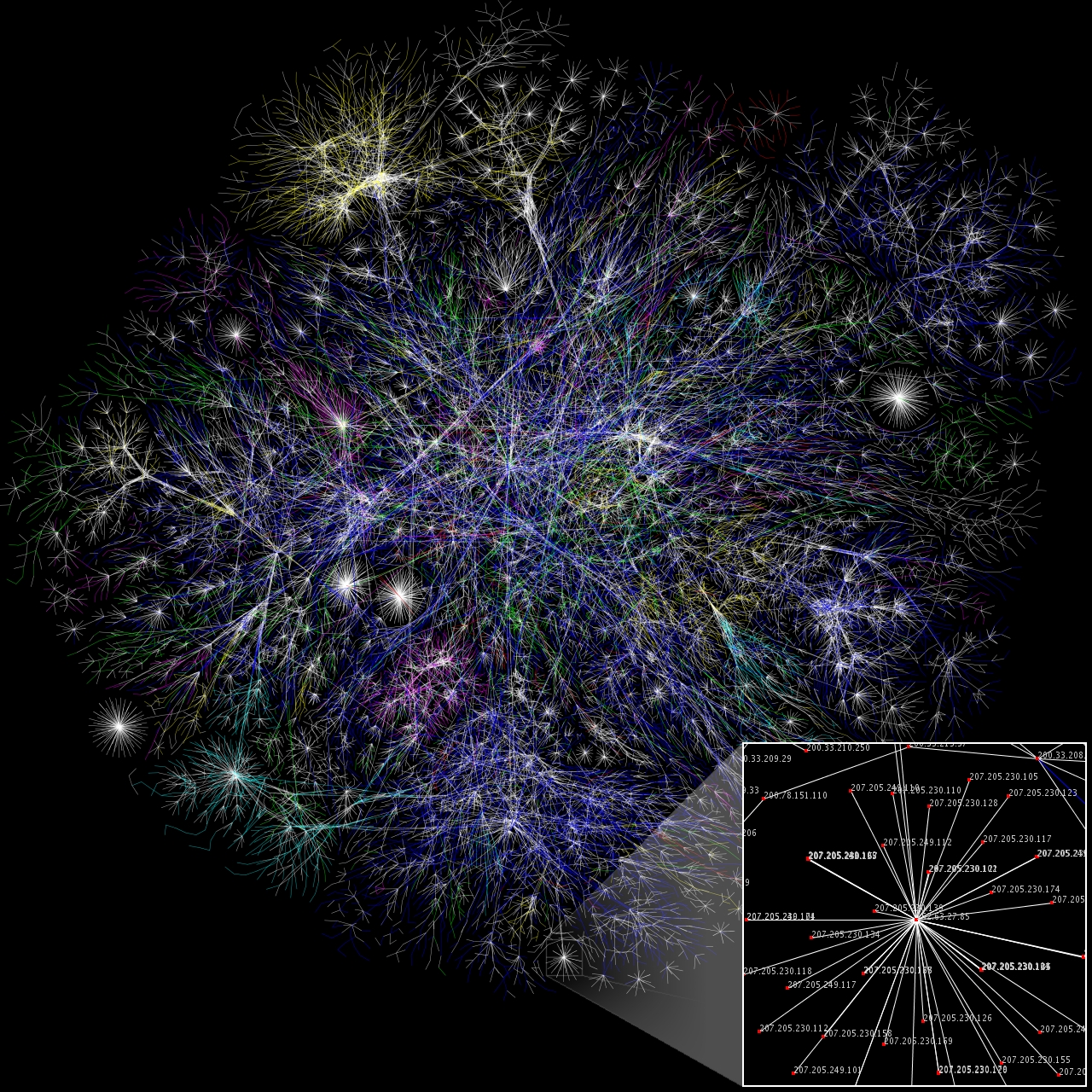
Social network analysis [image]. (2005).
Retrieved from https://upload.wikimedia.org/wikipedia/commons/d/d2/Internet_map_1024.jpg
·
Tuan, Y. (1991) Language and the Making of
Place. Annals of the Association of American Geographers, 81(4), 684-696. Retrieved
from http://.jstor.org/stable/2563430

No comments:
Post a Comment